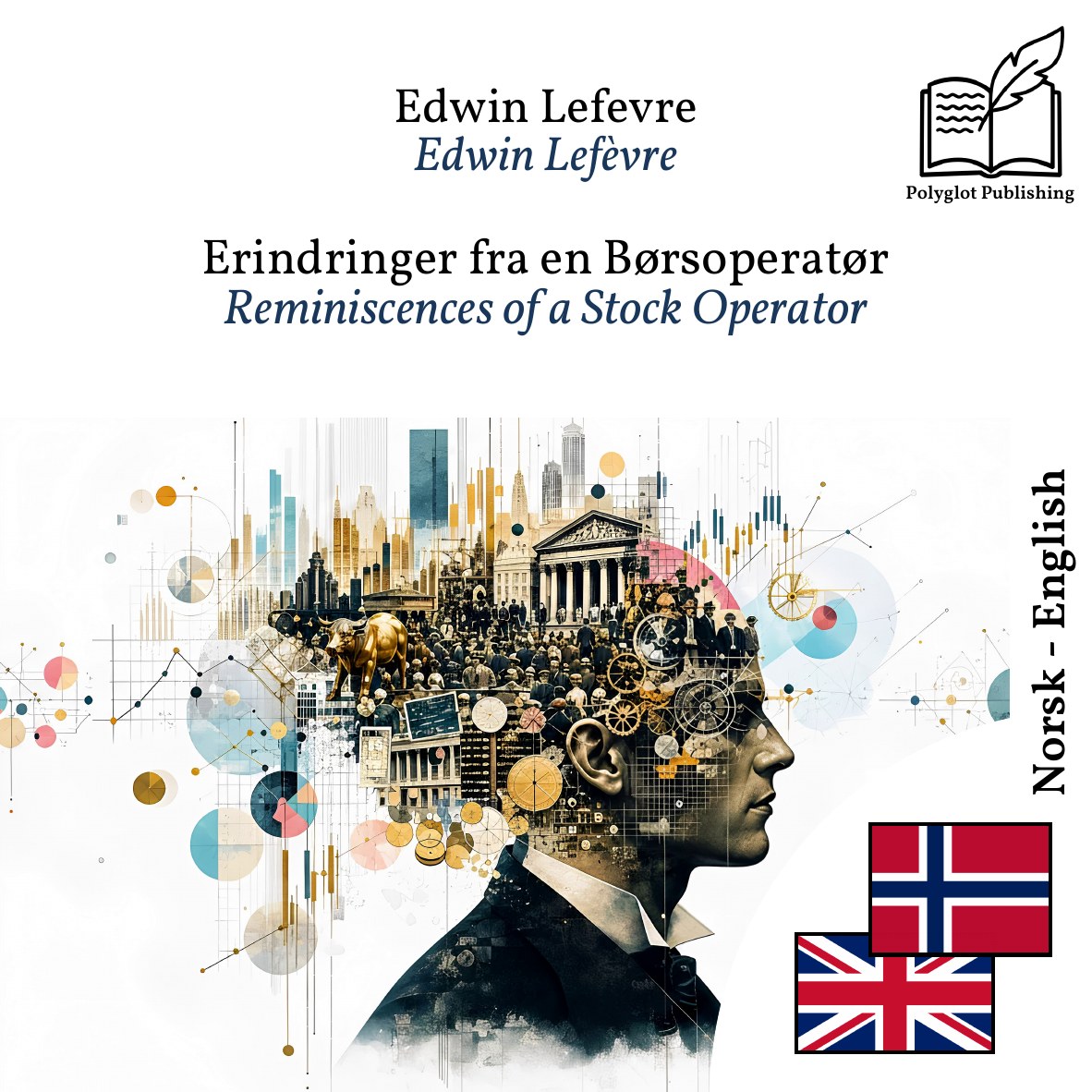
Edwin Lefevre
Wspomnienia Gracza Giełdowego
Książka papierowa: 40,99 €
Cyfrowy: 22,99 €
- Oryginalne wydanie
- 1923
- Wydanie dwujęzyczne
- 12 czerwca 2026
- Strony
- 629
- Trudność
- ★★☆
- Gatunki
- Biografie i autobiografie, Ekonomia
- Przetłumaczono z
- angielski
Streszczenie książki
Fragment
Każdy fragment w języku, którego się uczysz, z tłumaczeniem tuż pod spodem.
Jeg begynte å arbeide da jeg nettopp var ferdig med folkeskolen.
I went to work when I was just out of grammar school.
Jeg fikk jobb som kurstavlegutt på et meglerkontor.
I got a job as quotation-board boy in a stock-brokerage office.
Jeg var rask med tall.
I was quick at figures.
På skolen tok jeg tre års regning på ett.
At school I did three years of arithmetic in one.
Jeg var særlig flink i hoderegning.
I was particularly good at mental arithmetic.
Som kurstavlegutt skrev jeg opp tallene på den store tavla i
As quotation-board boy I posted the numbers on the big board in the customers’
kundesalen.
room.
En av kundene satt som regel ved tickeren og ropte ut kursene.
One of the customers usually sat by the ticker and called out the prices.
De kunne aldri komme for fort for meg.
They couldn’t come too fast for me.
Tall har jeg alltid husket.
I have always remembered figures.
Ikke noe problem i det hele tatt.
No trouble at all.
Det var mange andre ansatte på det kontoret.
There were plenty of other employes in that office.
Jeg ble selvfølgelig venner med de andre karene,
Of course I made friends with the other fellows,
men arbeidet mitt,
but the work I did,
når markedet var livlig,
if the market was active,
holdt meg for travelt opptatt fra klokka ti om morgenen
kept me too busy from ten A.M.
til klokka tre om ettermiddagen
to three P.M.
til at jeg fikk snakket noe særlig.
to let me do much talking.
Jeg bryr meg ikke om slikt,
I don’t care for it,
uansett,
anyhow,
i arbeidstiden.
during business hours.
Men et travelt marked hindret meg ikke i å tenke over arbeidet.
But a busy market did not keep me from thinking about the work.
Disse kursene var ikke aksjepriser for meg,
Those quotations did not represent prices of stocks to me,
så og så mange dollar per aksje.
so many dollars per share.
De var tall.
They were numbers.
Selvfølgelig
Of course,
betydde de noe.
they meant something.
De forandret seg hele tiden.
They were always changing.
Det var det eneste jeg trengte å interessere meg for —
It was all I had to be interested in —
forandringene.
the changes.
Hvorfor forandret de seg?
Why did they change?
Jeg visste det ikke.
I didn’t know.
Jeg brydde meg ikke om det.
I didn’t care.
Jeg tenkte ikke over det.
I didn’t think about that.
Jeg så bare at de forandret seg.
I simply saw that they changed.
Det var alt jeg hadde å tenke på fem timer hver dag og to på lørdager:
That was all I had to think about five hours every day and two on Saturdays:
at de alltid forandret seg.
that they were always changing.
Fabuła

Świat książki

Autor

Zalety metody dwujęzycznej – tryb wyświetlania: Synchronizacja wiersz po wierszu
Każdy wers oryginału ma swoje tłumaczenie bezpośrednio pod sobą, na tej samej wysokości. Nigdy nie musisz szukać, w którym miejscu jesteś: oko schodzi o jeden wers niżej i trafia dokładnie na zdanie, które właśnie przeczytało. To układ, który pozwala wziąć się za książkę w słabo znanym języku i nie odpaść po kilku stronach, a przy tym porównywać oba teksty niemal słowo w słowo.
Podobne książki

W hołdzie Katalonii
George Orwell

Słynne związki
Lyndon Orr
Autobiografia Benjamina Franklina
Benjamin Franklin

Kandydat
Joseph A. Altsheler

Biografia Harriet Martineau
Florence Fenwick Miller
Świat wczorajszy, tom 2
Stefan Zweig
Świat wczorajszy, tom 1
Stefan Zweig

Historia Rizala
José Rizal
Incydenty z życia niewolnicy
Harriet Jacobs
Pamiętniki zza grobu. Tom 4 (1815–1828)
Chateaubriand

Anarchizm i Inne Eseje
Emma Goldman
Państwo
Platon

Życiorys Fredericka Douglassa
Frederick Douglass

Sztuka wojny
Sun Zi

Książę
Niccolò Machiavelli

O powstawaniu gatunków
Charles Darwin
Przeglądaj witrynę
Inne języki, których możesz się nauczyć
- angielski
- francuski
- hiszpański
- niemiecki
- włoski
- rosyjski
- arabski
- bułgarski
- bengalski
- kataloński
- czeski
- duński
- grecki
- esperanto
- estoński
- perski
- fiński
- hebrajski
- hindi
- chorwacki
- węgierski
- indonezyjski
- japoński
- kazachski
- koreański
- litewski
- łotewski
- niderlandzki
- norweski
- portugalski
- brazylijski portugalski
- rumuński
- serbski (łacińskie)
- serbski (cyrylica)
- słowacki
- słoweński
- szwedzki
- suahili
- turecki
- ukraiński
- wietnamski
- chiński
- chiński (Tajwan)